Rules
The official Naruto Mythos TCG rulebook (Shinobi Shiren edition) explained: components, Attachment cards, advanced mechanics and the full FAQ.
Community summary of the publisher's official material: the EN rulebook (Shinobi Shiren edition), the Game mechanics page and the official FAQ. In case of conflict, the publisher's original takes precedence.
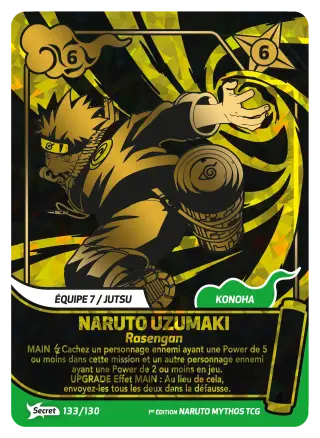
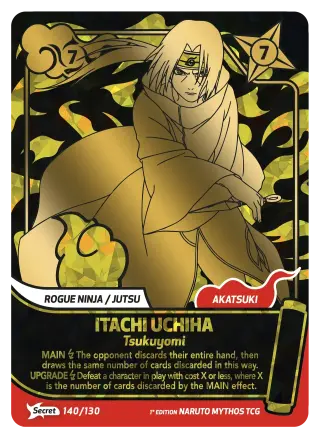

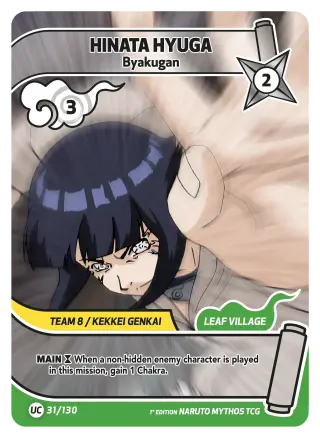
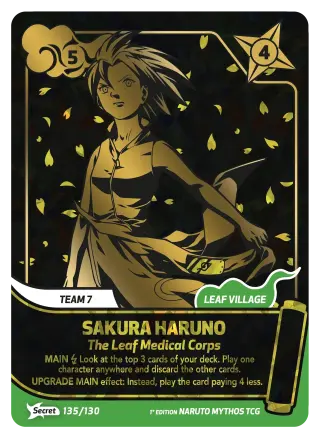
Rules in 10 minutes
DisTheGame →DisTheGame walkthrough covers rounds, combat and scoring. A quick start before the details below.

How to Play: Naruto Mythos TCG Rules
Index17
Gameplay overview
Who it is for, how long it takes, what it is about.
In Naruto Mythos TCG you and your opponent compete as the Kage of your hidden villages, deciding which ninja to send on each mission to score more points than your rival. Every game lasts exactly four rounds. After the 4th round, the player with the most Mission Points wins.
- A game lasts exactly 4 rounds. After round 4 the player with the most Mission Points wins; ties are broken by the Edge token.
- A new Mission card is revealed every round, and missions ACCUMULATE on the table (1 in round 1, up to 4 in round 4).
- Characters assigned to missions STAY on the table for the whole game and do not return to hand after losing a mission.
- Every mission is scored again EVERY ROUND: its winner (and the points it awards) can change between rounds.
- The Shinobi Shiren expansion adds a third card type: Attachments, which enhance characters or missions in play.
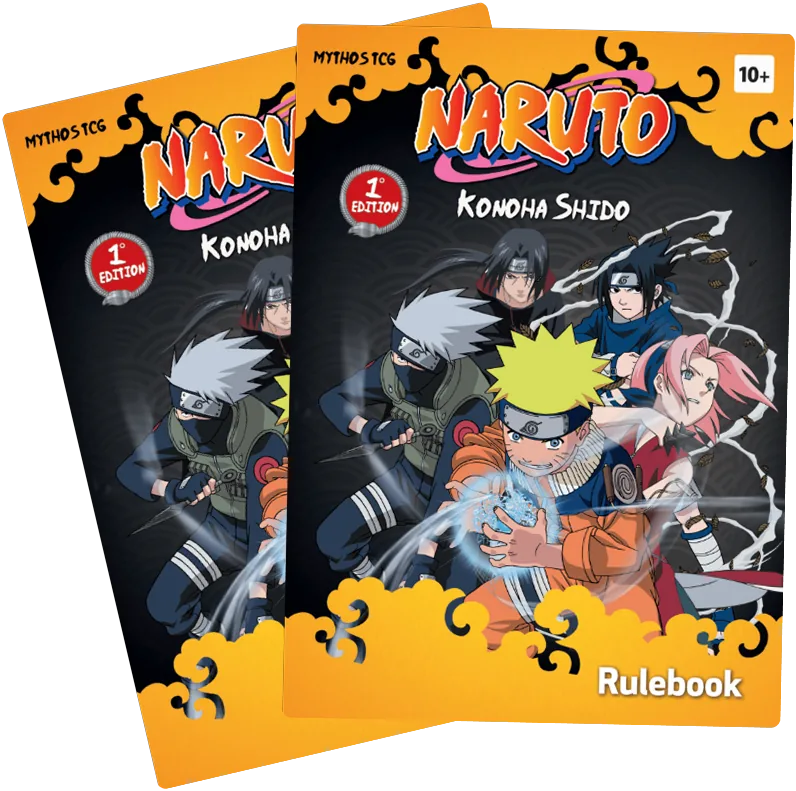
Components
Character cards, Mission cards, Attachment cards and tokens.
The game uses Character cards (your deck), a separate Mission deck, Attachment cards from the Shinobi Shiren expansion, and a set of tokens to track chakra and mission points.
Character cards
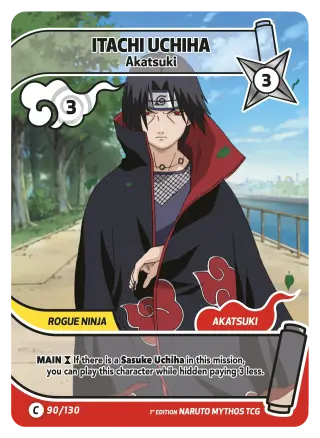
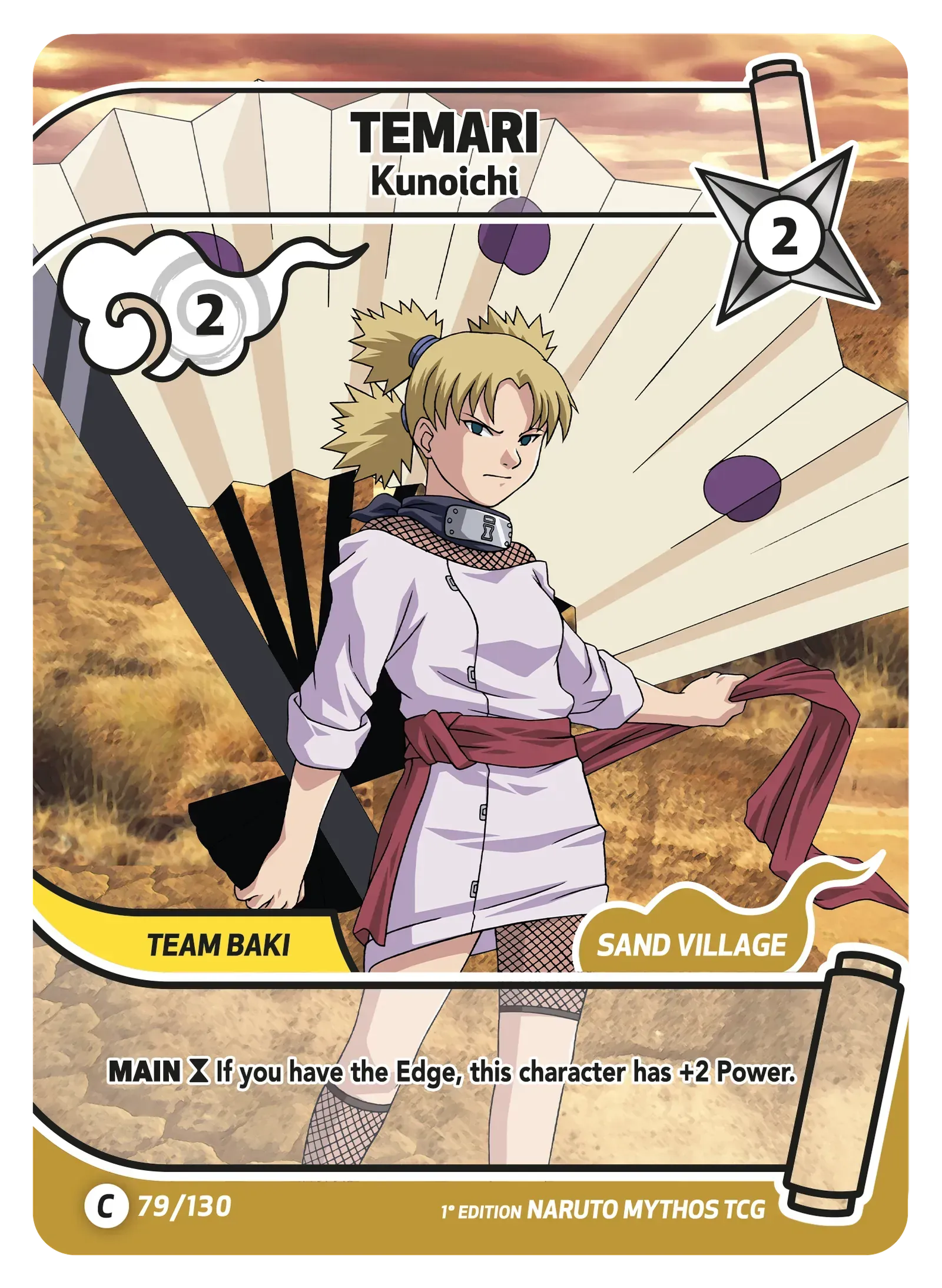
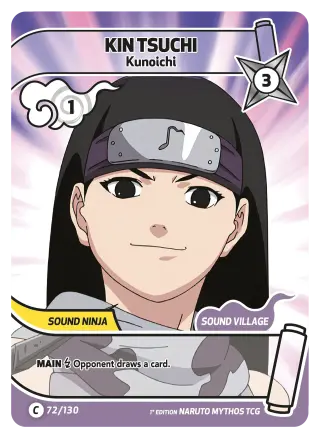
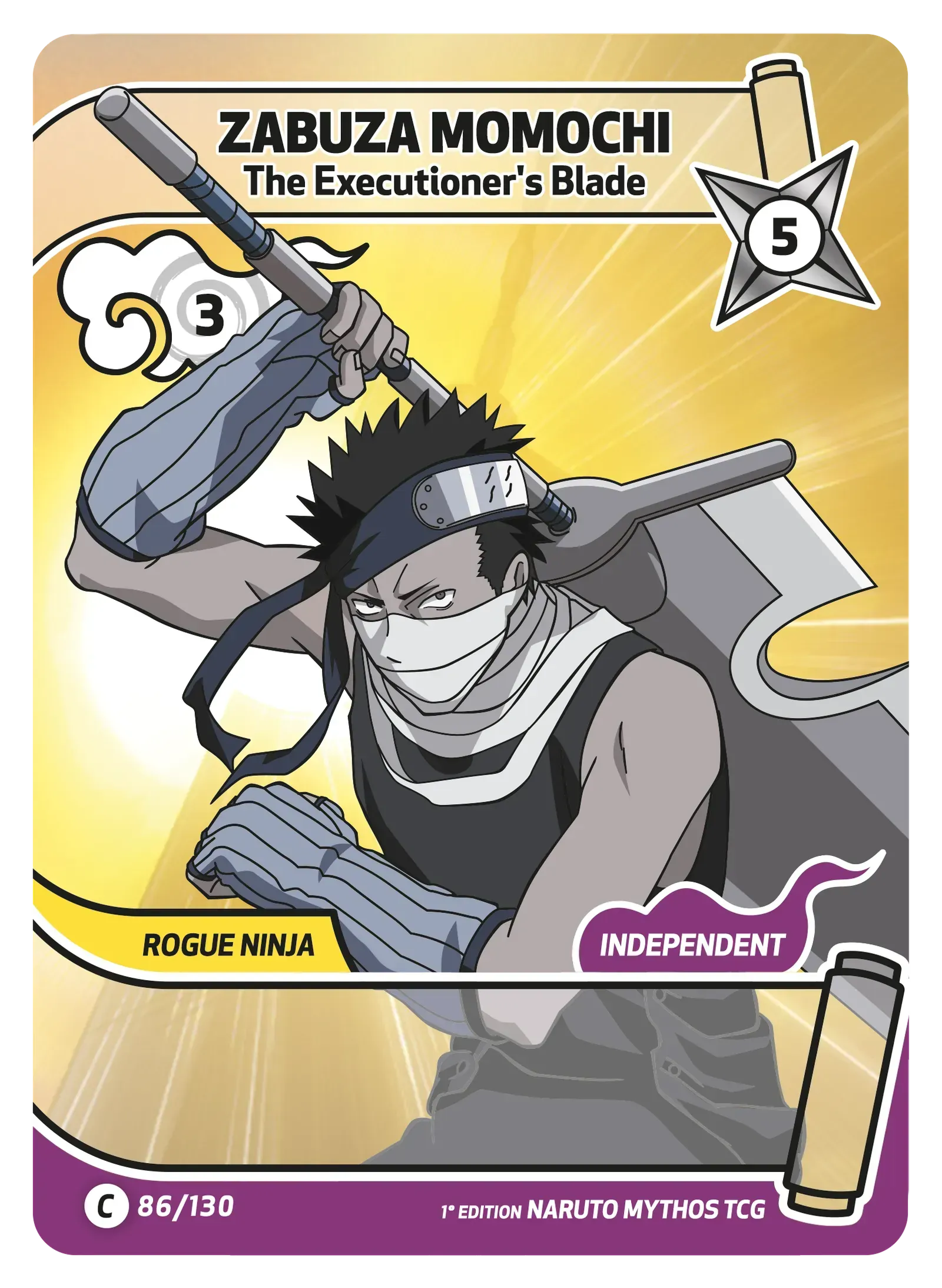
Character cards are played to assign ninjas to the Mission cards currently in play. Every card has a name, a description, a chakra cost, Power and, optionally, keywords and an effect.
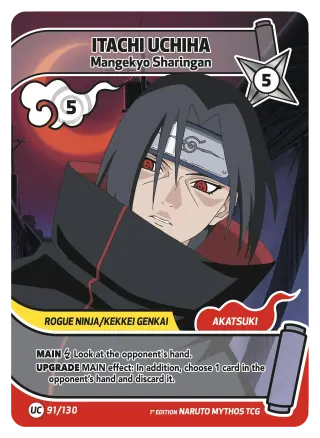
- 1 Character name
The name of the character. You can have only one Character card with the same name per mission on your side.
- 2 Character description
A descriptor that differentiates the card from other cards with the same character name (e.g. "Genin of Team 10").
- 3 Chakra cost
The amount of chakra points required to play this card.
- 4 Power
The number that is applied to win a Mission card.
- 5 Effect
Cards with effects carry an icon indicating their activation timing: Instant (activates when the character is played face-up) and Continuous (remains active as long as the character is face-up on the field).
- 6 Rarity
Represents the chance of finding the card in a booster pack.
- 7 Keywords
Keywords can be relevant in interactions with other cards and effects.
- 8 Faction
The character's faction, which may interact with other effects.
- · Set icon
The expansion symbol. If there is no icon, the card belongs to Set 1 (Konoha Shidō).
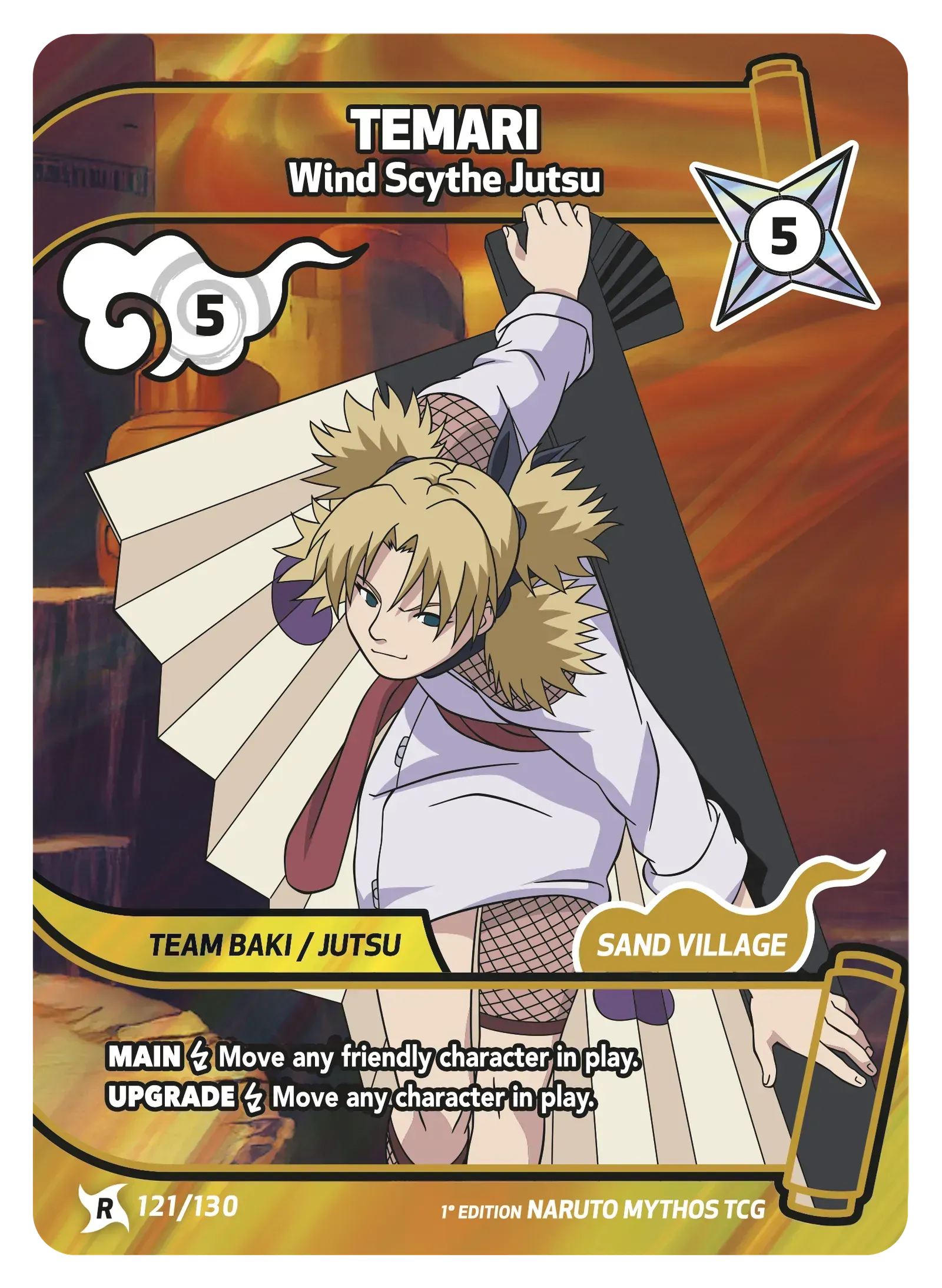
Mission cards
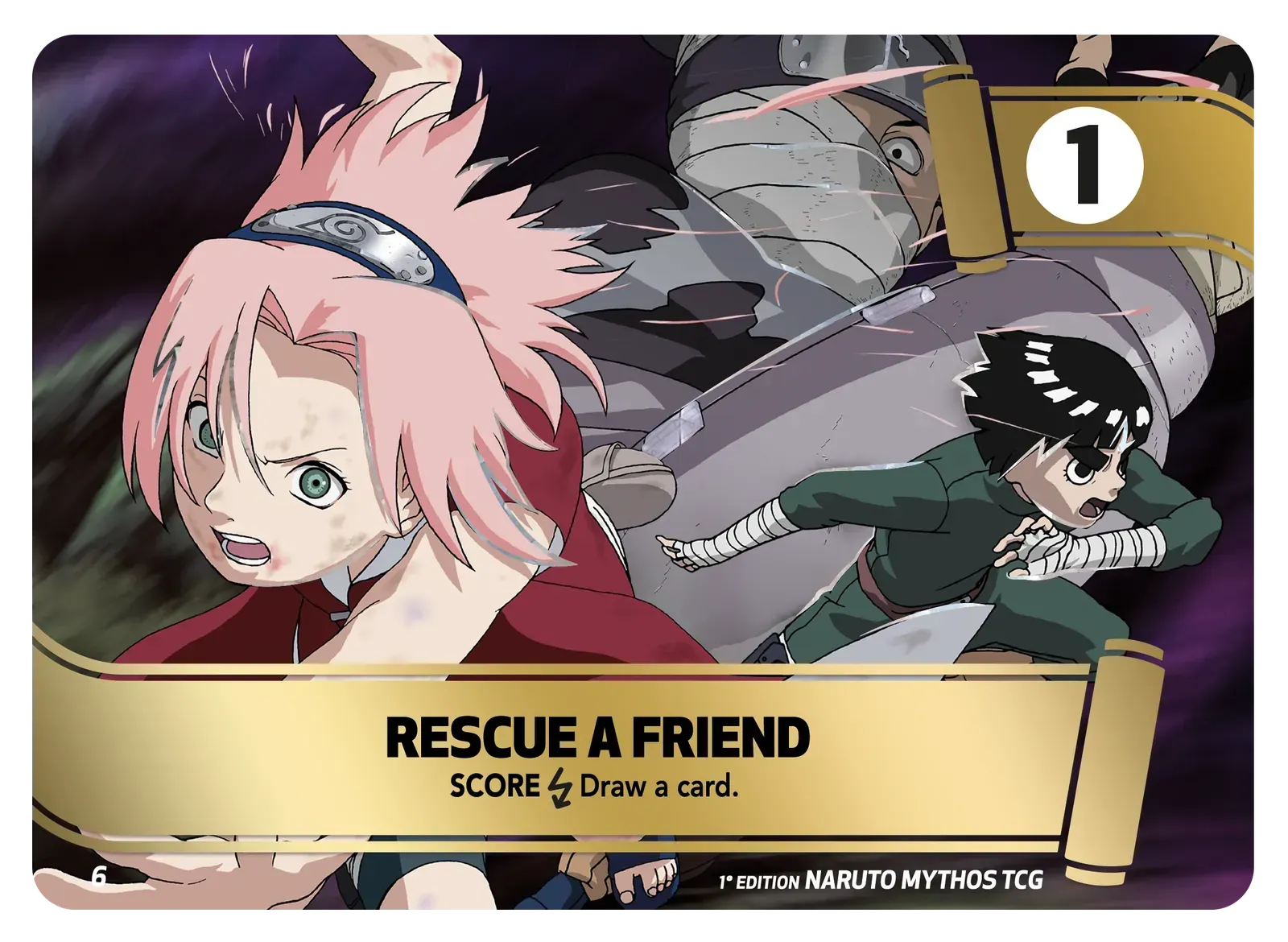
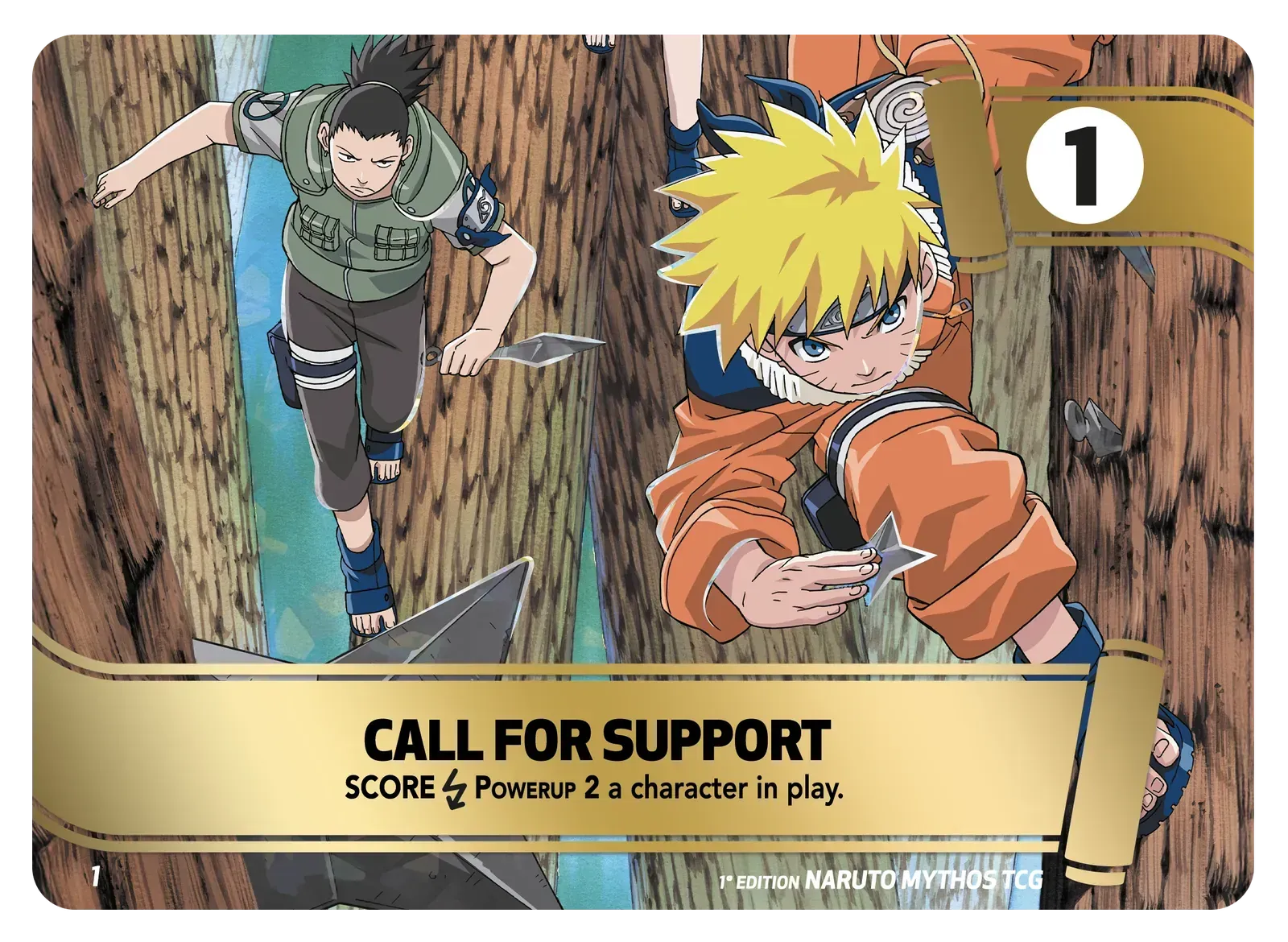
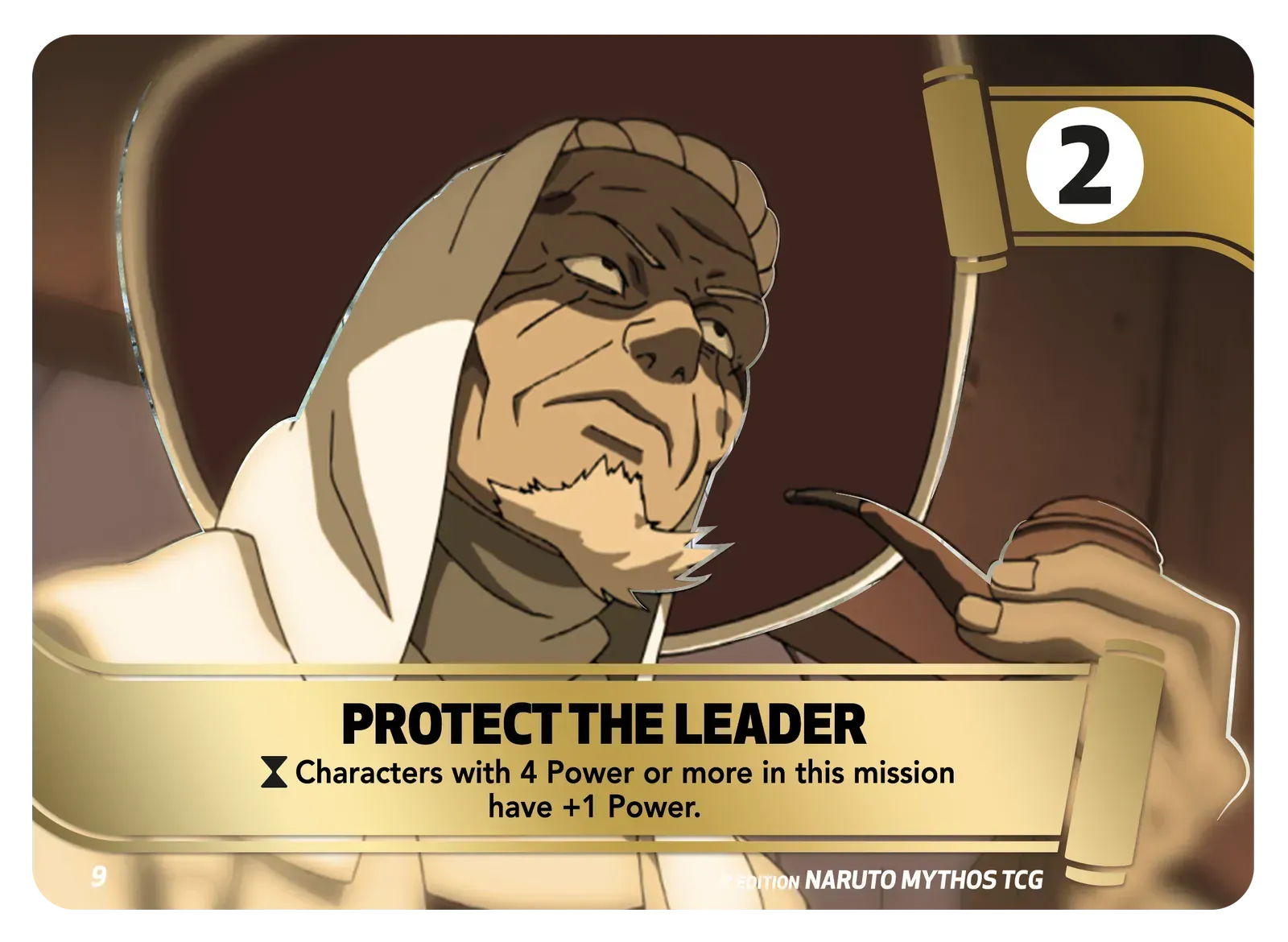
Every Mission card gives a base number of mission points plus additional points based on the rank it entered play with. The rank is determined by the round in which the mission hit the table.
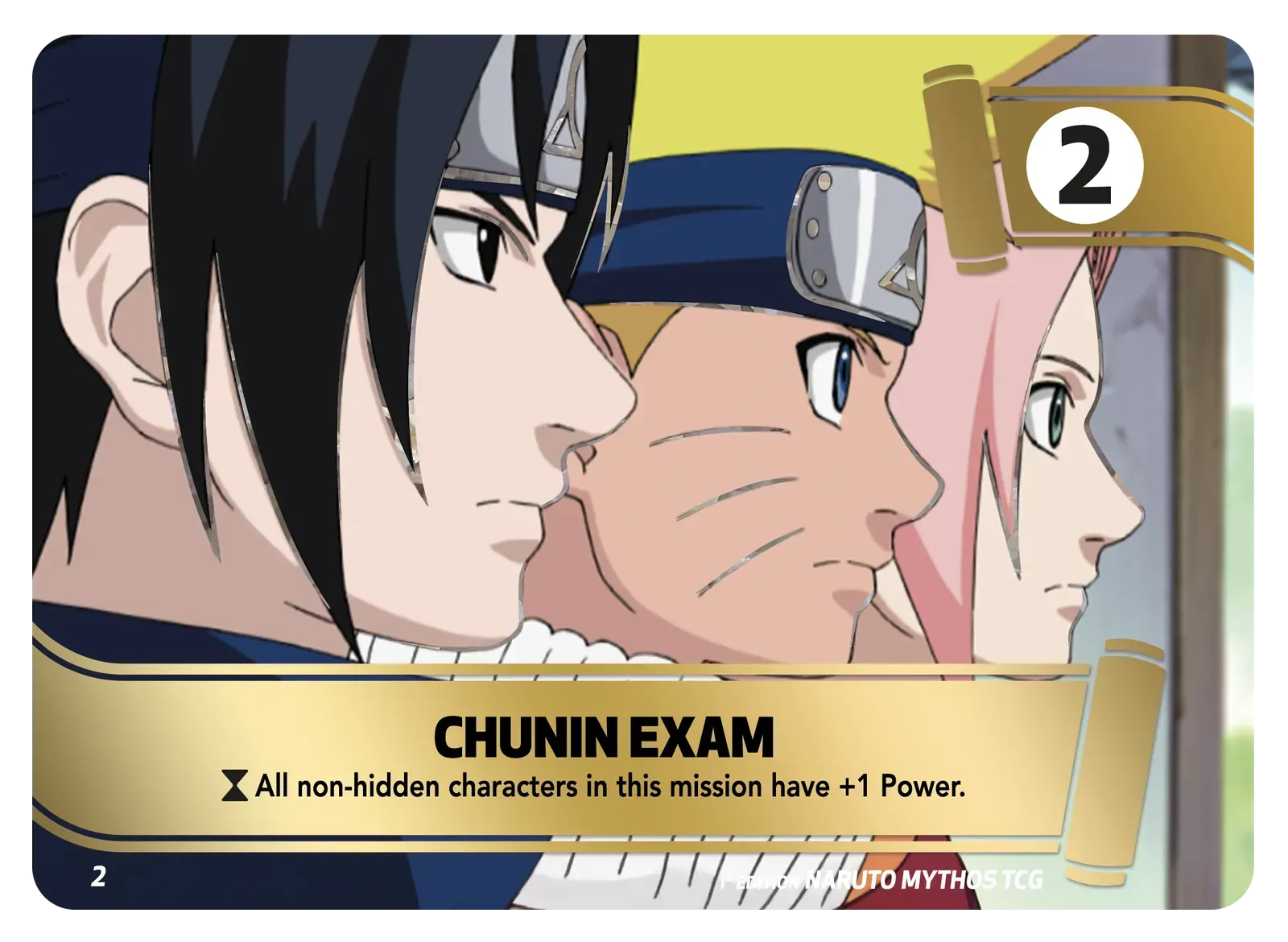
- 1 Title
The title of the mission.
- 2 Mission points
The base points awarded to the winner of this mission.
- 3 Effect
Effects that activate either during scoring or while in play.
Attachment cards
A new card type introduced by the Shinobi Shiren expansion. Attachments are not characters: they enhance a Character card or a Mission card in play and modify how it works. Full rules in chapter 10.
- Title
- The title of the attachment card.
- Chakra cost
- The amount of chakra points required to play the attachment.
- Power
- The value added to (or subtracted from) a character's Power, or added to your total when scoring a mission.
- Condition
- Specifies which type of card in play this attachment can be attached to (e.g. a friendly non-hidden character, or a mission).
- Effect
- The effect text with its timing icon, exactly as on Character cards.
- Keywords
- As on Character cards, they can interact with other effects.
- Faction
- The faction of the attachment card.
- Rarity
- The rarity symbol of the card.
- Set icon
- Attachments carry the Shinobi Shiren expansion icon.
Tokens
The Starter Pack contains tokens used to track your chakra points and mission points during the game. Place them in your play area and adjust them as your points go up or down. You will also find one Edge token. If you do not have the tokens with you, use any small objects, dice or custom counters.

Track your current chakra pool. Each round you gain 5 + 1 per character you have in play (including hidden ones). Unspent chakra is lost in the End phase.

Track the mission points you scored. After 4 rounds the larger total wins; ties go to the holder of the Edge token.

Given to the player who has the Edge during missions. They win all ties and start the next round (details below).
Building your first deck
At least 30 cards, exactly 3 mission cards, max 2 copies of the same version.
Your deck must contain at least 30 cards. On top of the deck, each player also chooses 3 different Mission cards.
The deck must contain at least 30 cards. There is no upper limit.
Any number of Character cards with the same NAME, but at most 2 copies of a specific VERSION. The version is indicated by the expansion name and the numerical code at the bottom of the card. Art variants of the same coded card do not count as a different one.
You can include any number of "Naruto Uzumaki" cards, but only up to 2 copies of "Naruto Uzumaki - Genin of the Leaf Village (Set 1 - 9/130)".
You choose exactly 3 different Mission cards. They are NOT mixed into your personal deck: during setup they are put together with your opponent's mission cards to form the mission deck.
Setup
From determining the first player to the starting hand.
Before the first round begins, both players go through setup.
- 1
First player
Randomly determine the first player (for example with a die or a coin). That player receives the Edge token.
- 2
Mission deck
Both players shuffle the 3 mission cards they chose face-down and randomly select 2 of them. The 2 cards from each player are put together into the mission deck, ALTERNATED so that the top and 3rd card belong to the player with the Edge token. Each player is left with 1 mission card that is not used this game. Set it aside, face-down at all times.
 3
3Starting hand
Both players shuffle their deck and draw 5 cards. Each player may then return their whole hand to the deck, reshuffle and draw 5 new cards (mulligan, but only once; the player with the Edge token decides first).
Round phases
Start → Action → Mission → End. Four times.
Every round follows a fixed sequence of phases. A game lasts exactly 4 rounds. After the fourth you compare total mission points.
- 1
Start phase
A Mission card is drawn from the top of the mission deck and placed face-up between the players, joining those already in play. Then each player gains a base 5 chakra + 1 per character they have in play (including hidden ones). Finally each player draws 2 cards and you move to the Action phase.
- 2
Action phase
The player with the Edge token takes the first turn. Players alternate playing 1 card (a character or an attachment) onto a mission on the field, face-up or face-down (hidden), or revealing a previously played hidden card, or PASSING. The first player to pass in a round gains (or keeps) the Edge token. Once one player passes, the other may take successive turns until they pass too. Once both have passed, move to the Mission evaluation phase.
- 3
Mission evaluation phase

Compare the total Power of each player's characters on each mission, starting with the D-rank mission. The higher Power wins the mission; ties go to the player with the Edge token. You need at least 1 Power to win and score a mission. The winner activates SCORE effects from the Mission card and from their characters on that mission. Repeat for the remaining missions in rank order. You score as many missions as the number of the current round.
- 4
End phase
The round ends. If this was round 4, compare final scores. Otherwise both players discard leftover chakra and any Power tokens on characters, then a new round begins with a Start phase. Characters and missions STAY on the table.
How to play cards
Three ways to play during the Action phase.
On your turn you must play a card or pass (and stop participating in the Action phase for the rest of the round). You have three options:
Play a card from your hand face-up to a mission, paying its chakra cost and applying its MAIN effects.
Play a card from your hand face-down to a mission, paying 1 chakra. The character is now hidden and its effects are not activated.
Reveal a previously played hidden character, paying its full printed chakra cost and applying MAIN and AMBUSH effects. Revealing counts exactly as playing a character.
To pay a chakra cost, return chakra tokens of an equal value to the shared pool. You may check the cost of your own hidden characters in private to make sure you can reveal them. You can only have 1 character with the same name per mission on your side. After playing a card your turn ends, unless your opponent has already passed, in which case you keep taking turns until you pass too.
Character upgrades
A same-name character with a higher cost, played on top.
You cannot assign two characters sharing the same name to the same mission side. You can, however, upgrade a character by playing a Character card with the same name but a HIGHER chakra cost (not the same or lower).
- 1When upgrading you pay only the difference in chakra cost, not the full cost of the new card (a 5-cost card on a 4-cost card costs 1 chakra).
- 2Fully cover the cheaper card: all text on the old, cheaper card is no longer referenced during gameplay.
- 3Apply the MAIN and UPGRADE effects of the new, more expensive card.
- 4An upgraded character counts as a SINGLE character, so it generates only 1 chakra in the Start phase regardless of how many cards are in the stack.
- 5For the purpose of effects only the top card of the stack is considered; the others are treated as "glued" to it. If the top card becomes hidden, the whole stack is turned face down.
- 6If an effect makes the top card leave play (defeated, returned to hand or to the deck), all cards beneath it are discarded first, in order from top to bottom of the stack.
- 7An upgraded character keeps the status of the previous card: Power tokens, for example, transfer to the newly played card.
- 8You can upgrade even when the card has no UPGRADE effect.
Effects and Power tokens
Instant vs Continuous, resolution order, Power tokens.
Card effects are applied according to the timing indicated, and in order from top to bottom of the card.
Activates once, when the card enters play. All Instant effects are optional unless the text says otherwise, for example with MUST.
"MUST, IF ABLE" lets you play the card even if the effect cannot be applied in full. If it can be applied, however, you must apply it.
Always active while the card is face-up on the field. Most Continuous effects are STATIC: active all the time.
"All characters have +1 Power" is a static effect. Some static effects have a condition, e.g. "if you have 3 or more characters in this mission".
Each Power token on a character adds +1 Power. At the end of every round remove all Power tokens from all characters. The main source of Power tokens is the POWERUP effect. Hidden cards count as characters, so they can receive tokens too, and tokens stay on the card when it switches between hidden and face-up.
- ›You cannot apply only part of an effect: if you choose to apply it, you apply all of it, as much as possible.
- ›If playing a card triggers an effect on another card already in play, resolve those triggered effects first, before the effects of the newly played card.
- ›When several effects trigger at the same time, the turn player chooses the order in which they apply.
- ›Some UPGRADE effects modify parts of other effects. Remember to integrate the change when applying the MAIN effect.
- ›The full resolution order and trigger chains are covered in chapter 15.
Attachment cards
The new card type from the Shinobi Shiren expansion.
Attachments enhance Character cards or Mission cards in play and modify how they function. You play them during the Action phase instead of a character, paying the chakra cost printed on the card.
1Each attachment card specifies which type of card in play it can be attached to (the condition on the card). Without a valid host you cannot play it.
Slide the card under the right side of the host card, leaving the attachment's Power and effects visible.
Each card (Character and Mission) can host one attachment per player, so two at most. If you play an attachment on a card that already holds one of yours, you must discard the existing one.
Attachments are not characters: effects that target characters do not affect attachments, and vice versa.
Face-up attachments do not generate chakra at the start of the round.
Attachments may be placed face-down as hidden characters, following the normal rules (1 chakra). When played while hidden, all attachment rules apply normally: if no valid host is available in that mission at that moment, the attachment cannot be played.
If a host's status changes so that the attachment's condition is no longer met, discard the attachment immediately. Example: an attachment that says "attach to a friendly non-hidden character" is discarded when that character becomes hidden.
Attachments that modify a character's Power add or subtract their value from the character's total Power, both when checking card effects and when scoring missions.
Some mission attachments have a Power value of their own. Add it to your total when scoring that mission.
When a character with an attachment leaves play, the attachment is discarded.
Attachment rules are on pages 18–20 of the official rulebook.
Mission scoring
Ranks D/C/B/A and re-scoring every round.
The rank of a Mission card is determined by the round it entered play. Every mission awards the base points printed on the card PLUS additional points for its rank. Note: every round you evaluate ALL missions on the table (starting from rank D), so the same mission is scored multiple times, and its winner can change from round to round.
Example: a mission that entered in round 3 with a base of 2 points is a B-rank mission and awards 2 (base) + 3 (rank B) = 5 points for every round in which you win it.
| Player 1 | Player 2 | |||||||
|---|---|---|---|---|---|---|---|---|
| D | C | B | A | D | C | B | A | |
| Round 1 | 1+3 | – | – | – | 0 | – | – | – |
| Round 2 | 1+3 | 0 | – | – | 0 | 2+2 | – | – |
| Round 3 | 0 | 0 | 3+2 | – | 1+3 | 2+2 | 0 | – |
| Round 4 | 1+3 | 0 | 3+2 | 0 | 0 | 2+2 | 0 | 4+3 |
| Partial total | 12 | 0 | 10 | 0 | 4 | 12 | 0 | 7 |
| Total | 22 | 23 | ||||||
Player 2 wins!
In each cell the first number is the rank bonus and the second the base points from the mission card (e.g. "1+3" for a D-rank mission: +1 for the rank, 3 from the card). "–" = the mission is not in play yet, "0" = no points scored. Mission D goes to Player 1 in some rounds and Player 2 in others, which is re-scoring every round in action.
Winning the game
After 4 rounds, the most mission points wins.
At the end of the 4th round the player with the most mission points wins. In case of a tie, the player in control of the Edge token at the end of the game is the winner.
- 1A game lasts exactly 4 rounds. There is no sudden-death threshold.
- 2After round 4, the player with more mission points wins.
- 3A points tie is broken by the Edge token: its holder wins.
- 4You score points by winning missions (base from the card + rank bonus).
Play etiquette
A short code of good practice at the table.
Mythos TCG has no online judges. Most games happen at home or at a community event. These rules come straight from the rulebook.
- 1You can always look at your own hidden characters.
- 2Always be clear about the order of the played cards, especially hidden ones: do not move them around during play, and help your opponent if they ask about playing order.
Cheat sheet: game flow
The simplified game plan from the rulebook (p. 22).
A short step list to keep next to the table. The order matches the official "Simplified game plan" exactly.
Activate all start-of-match effects. Both players shuffle their decks and draw 5 cards. The Edge player first chooses whether to mulligan (shuffle the hand back and draw 5 new cards), then the other player makes the same choice.
Reveal and put the next mission in play. Both players gain 5 chakra + 1 per character they have in play. Both draw 2 cards. Activate all start-of-round effects.
The Edge player plays a card (character or attachment) or passes. Then the other player does the same. Repeat until both have passed. The first player to say "pass" takes the Edge token.
Check total Power and score mission D (the Edge wins ties). Repeat for every other mission in play, in order C, B, A.
Activate all end-of-round effects. Discard all chakra and Power tokens. Start a new round.
Advanced mechanics
Effect order, chains, targeting, control.
The publisher runs a separate "Game mechanics" page that settles situations the rulebook does not cover. This chapter follows it. It starts with the Card Play Sequence: the order in which everything triggered by a played card is resolved.
- 1
A card is played
The starting point of the sequence. Work through the following steps from top to bottom.
- 2
Static effects
Check and apply simultaneously all STATIC continuous (⧗) effects. Repeat this operation after every following step.
- 3
Effects triggered by the card entering play
Activate continuous effects triggered by the new card entering play. When several trigger at once, the turn player decides the order.
- 4
Trigger chain
If those effects trigger further effects, add them to the chain and resolve them one by one, starting with the most recent and then working backwards, from newest to oldest.
- 5
First ↯ effect of the played card
Only now do you apply the first instant effect of the card you played.
- 6
Effects triggered by that effect
Activate continuous effects triggered by the played card's effect. Again: the turn player decides the order of simultaneous ones, and new triggers join the chain.
- 7
Remaining ↯ effects of the played card
Apply the next instant effects of the played card and repeat the whole procedure for each of them.
The golden rule of the chain: the LAST effect to activate is the FIRST to resolve. Effects that activate at the same time are resolved at the same timing, in the order decided by the turn player. You untangle the knot backwards until you reach the effect that started it.
- Snapshot targeting
- Effects with multiple targets apply to all of them simultaneously, against a snapshot of the situation BEFORE the effect, not one by one. Example: Kakashi (Leader of Team 7) has 3 Power and gives +1 Power to other Team 7 characters in the mission, so Naruto counts as 4 and Sasuke as 5. The opponent plays Kabuto Yakushi (Nirvana Temple Jutsu) and hides all characters with 4 Power or less: Kakashi and Naruto get hidden. Sasuke stays safe, because his Power only drops to 4 after the effect has already checked its targets.
- Core stats
- When several static effects apply at once, they are applied simultaneously to the card's Core stats: the printed Power plus Power tokens, ignoring all other static effects. That is what stops bonuses from looping.
- Mission state changes
- Static effects with a condition must be re-checked whenever the state of the mission changes: a card was played there, a Power token was applied, or a character was moved from or to it. A card played in another mission does not change this mission's state.
- The turn player
- Always decides the order of simultaneous triggered effects when the order matters. Mission effects are always last. If there is no turn player at that moment (end of round, scoring), the player with the Edge is considered the turn player.
- The Decider
- The player who carries out an effect. With "defeat all enemy characters in this mission" you are the decider; with "the opponent defeats all their characters" they are. It matters wherever card order is meaningful: for example the order in which cards enter the discard pile.
- Discard pile
- It cannot be reorganised during play. If an effect defeats several targets, the decider chooses the order.
- No repetition
- You can never PLAY a character into a mission that already holds a character with the same name, nor MOVE a character (friendly or enemy) there if it would create a duplicate. If another interaction still causes it (taking control, returning control, removing the top card of an upgrade, playing a random character), the newly arrived duplicate is immediately discarded; this triggers no effects and does not count as a defeat.
- Take control
- All opponent cards on your side of the missions follow the Take Control rules. Picture it like this: the card that takes control receives a CONTROLLER token, and the controlled card a CONTROLLED token that follows it wherever it is moved or however its state changes.
- How control breaks
- Control ends when: the controller is hidden; the controller or the controlled card is defeated; the controller or the controlled card leaves play (returned to deck or hand); the controller itself becomes controlled. The controlled card then returns to its owner in its current state, in the same mission on their side.
- Control and upgrades
- You cannot use controlled cards to upgrade or be upgraded over. A controller card that gets upgraded keeps the controller condition. If the controller leaves play and is played again, it no longer controls anything: the link was lost the moment it left play, and the controlled card returns to its owner as soon as possible.
- A controlled card leaves play
- Discarded or defeated, it goes to the OWNER's discard pile; returned to hand, it goes to the owner's hand.
Glossary
Every term and keyword.
Quick counters first, then the glossary from the last page of the rulebook (p. 23), plus two entries clarified in the official FAQ (personal deck, weakest/strongest).
- Chakra
- The main resource. Each round you gain 5 + 1 per character in play; unspent chakra is lost at the end of the round. You pay it to play cards.
- Power
- A character's combat value. It is summed per side during the Mission evaluation phase.
- Mission points
- Scored by winning missions. After 4 rounds the larger total wins.
- Edge
- The priority token. The first pass in a round grants or keeps the Edge; its holder wins all ties and starts the next round.
- Personal deck
- Your deck of cards. When it runs out you simply stop drawing, even when an effect asks you to draw.
- Discard pile
- The zone where your discarded cards are placed. Do not rearrange the order of the cards during play unless an effect says so.
- MAIN
- This effect triggers every time you play the character.
- UPGRADE
- This effect triggers only when you play the character as an upgrade.
- AMBUSH
- This effect triggers only when you play (i.e. reveal) this character from a hidden state.
- SCORE
- This effect triggers only when you win the mission.
- FIRST STRIKE
- This effect triggers only if this character is the first character you play this round.
- DUEL
- This effect triggers only if the character named after the keyword is present in this mission, whether friendly or enemy.
- CHAKRA +X
- This character provides X additional chakra points in the Start phase, on top of the normal production.
- POWERUP X
- Put X Power tokens on a character. If no target is specified, it is the same character that triggered the effect.
- PRINTED POWER
- The Power printed on the card, ignoring Power tokens, attachments and other effects.
- Hidden
- Any Character card that is face down.
- Non-hidden
- Any Character card that is face up.
- Defeat
- The character is placed in the discard pile of its owner.
- Hide
- The character is turned face down.
- Move
- Place the character in another mission, following what the effect states.
- Take control
- The card is temporarily in your control. If any effect would remove it from play, it goes back to the original owner. If the source of the control gets hidden, leaves play or changes sides, return the controlled card to its owner (same mission, other side).
- Enemy
- A card on the opponent's side. All opponent characters are Enemy characters.
- Friendly
- A card on your side. Your characters are Friendly to all your other characters. A character is not a Friend of itself.
- Leave play
- When a card in play goes from a mission to the discard pile, hand or deck. All cards under it are discarded.
- Weakest / Strongest
- The weakest character is the one with the lowest Power, the strongest the one with the highest. Most effects target a single weakest or strongest character; if several are tied, you choose which one is affected. Effects that target ALL the weakest or strongest apply to every tied character.
FAQ
The basics straight from the rulebook plus the publisher's official rulings from the FAQ page (as of 29 August 2026), including answers about specific cards. Use the search box to filter.
64
Missions and scoring
Characters and hiding
Upgrades
Effects, timing and targeting
Chakra, Power and tokens
Deck, hand and discard pile
Friendly, enemy and control
Card variants and languages
Winning, tournaments and time limits
Specific card rulings
What next
You know the rules now. This is where the rest of the site starts.
Downloads
EN, 24 pages, with Attachment cards
PDF →First expansion info
PDF →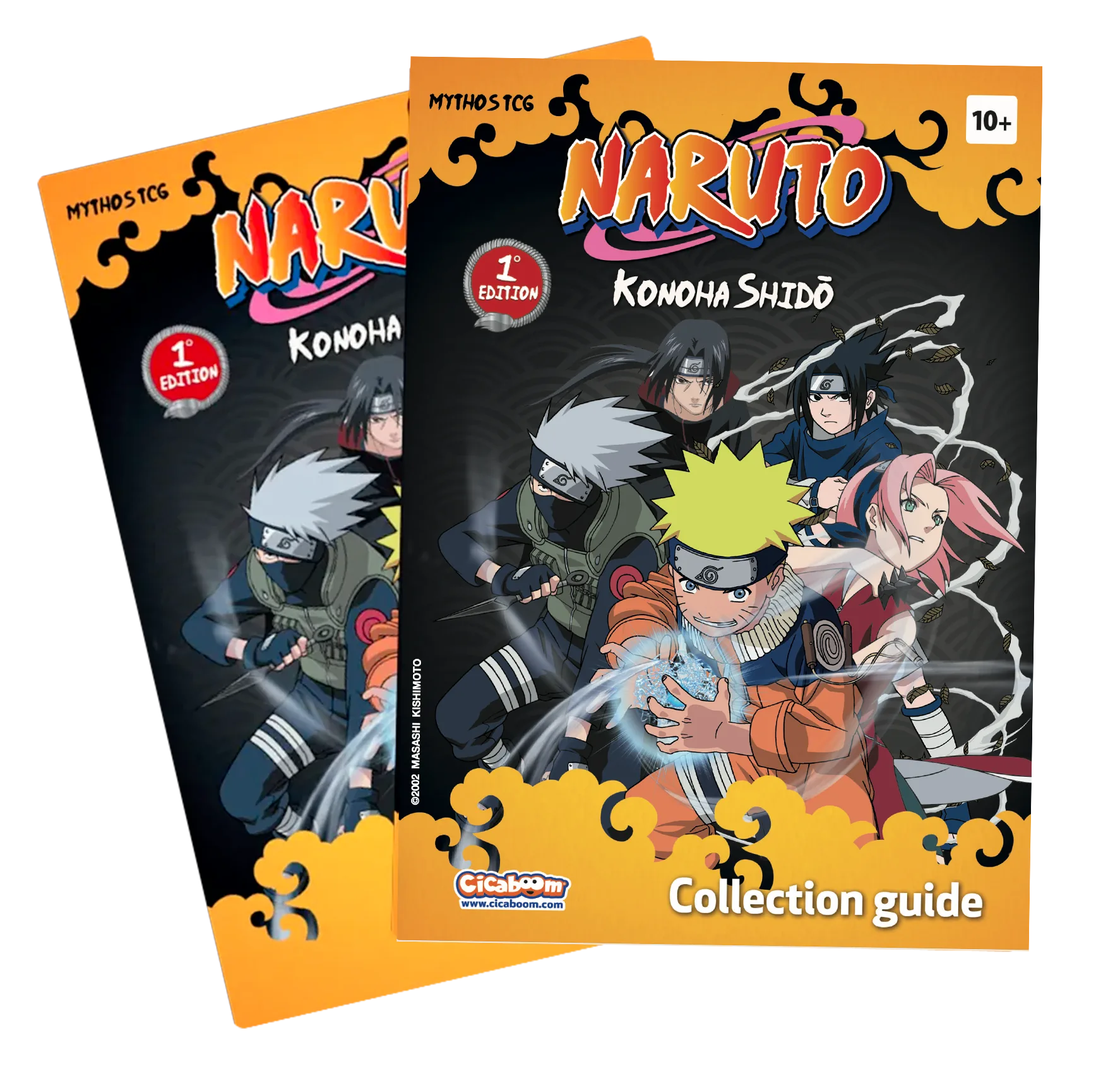
Card list + rarities
PDF →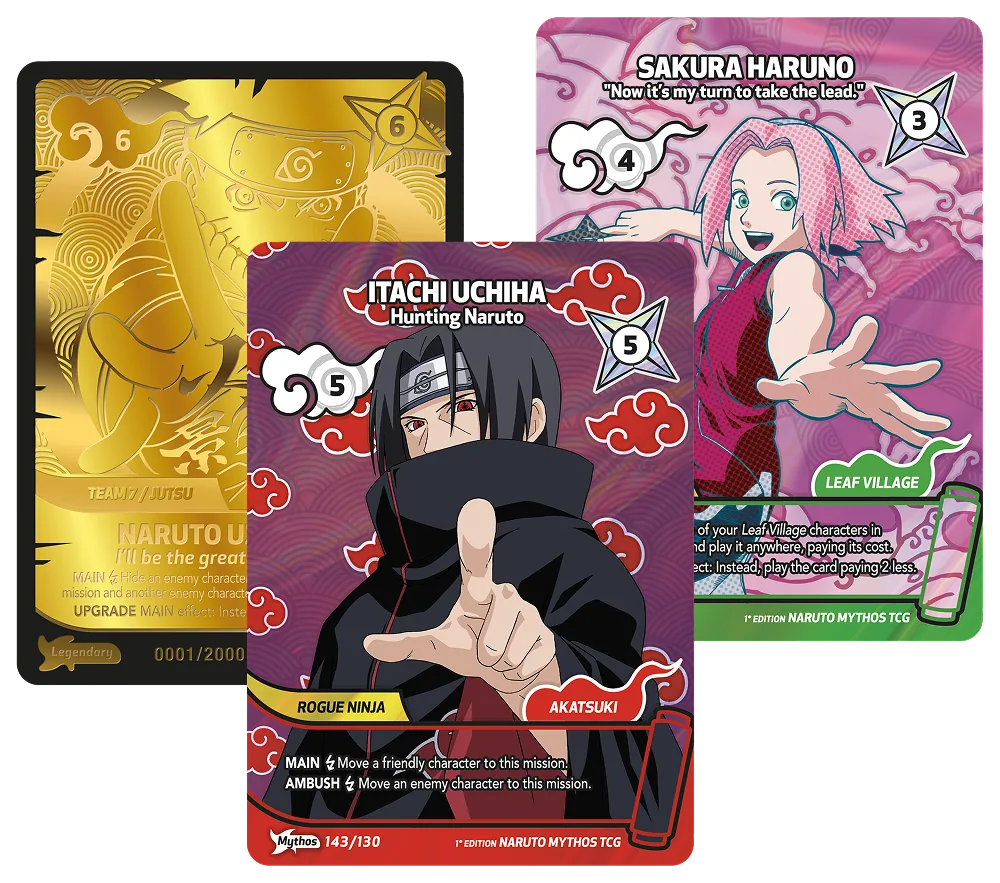
Page based on the official rulebook and narutotcgmythos.com/how-to-play.
Game design: Studio Supernova (Marcello Bertocchi, Luca Ricci), based on an idea by Alessio Meda. Rulebook author: Fulvio Giorgio Fantino © 2025.